
There is one thing that’s pretty common in Singapore SME marketing meetings. You see the rankings go flat and the first plan of action is to “publish more”. The usual reaction is to question the writing, or to order more of it.
Another ten blog posts, a fresh batch of keywords, a content calendar stretching to Christmas.
Six months and a few thousand dollars later, the rankings sit exactly where they started. You open Google Search Console and read the indexing report, though, and the story is often somewhere else entirely: a chunk of those new pages are sitting under “Crawled, not indexed.” This just means Google crawled them, but they still weren’t selected for indexing
The content was never the problem, and no amount of extra publishing moves a page Google has already declined to index. That gap between effort and result gets easier to understand once you stop treating SEO as a single job.
That ‘elsewhere’ is what the 3 C’s of SEO are for. Content, Code and Credibility are the three things a search engine weighs, and on any given site one of them is the bottleneck while the other two are fine. A site can be genuinely strong on one and quietly broken on another, which is why adding content to a site with a crawling problem is never the solution.
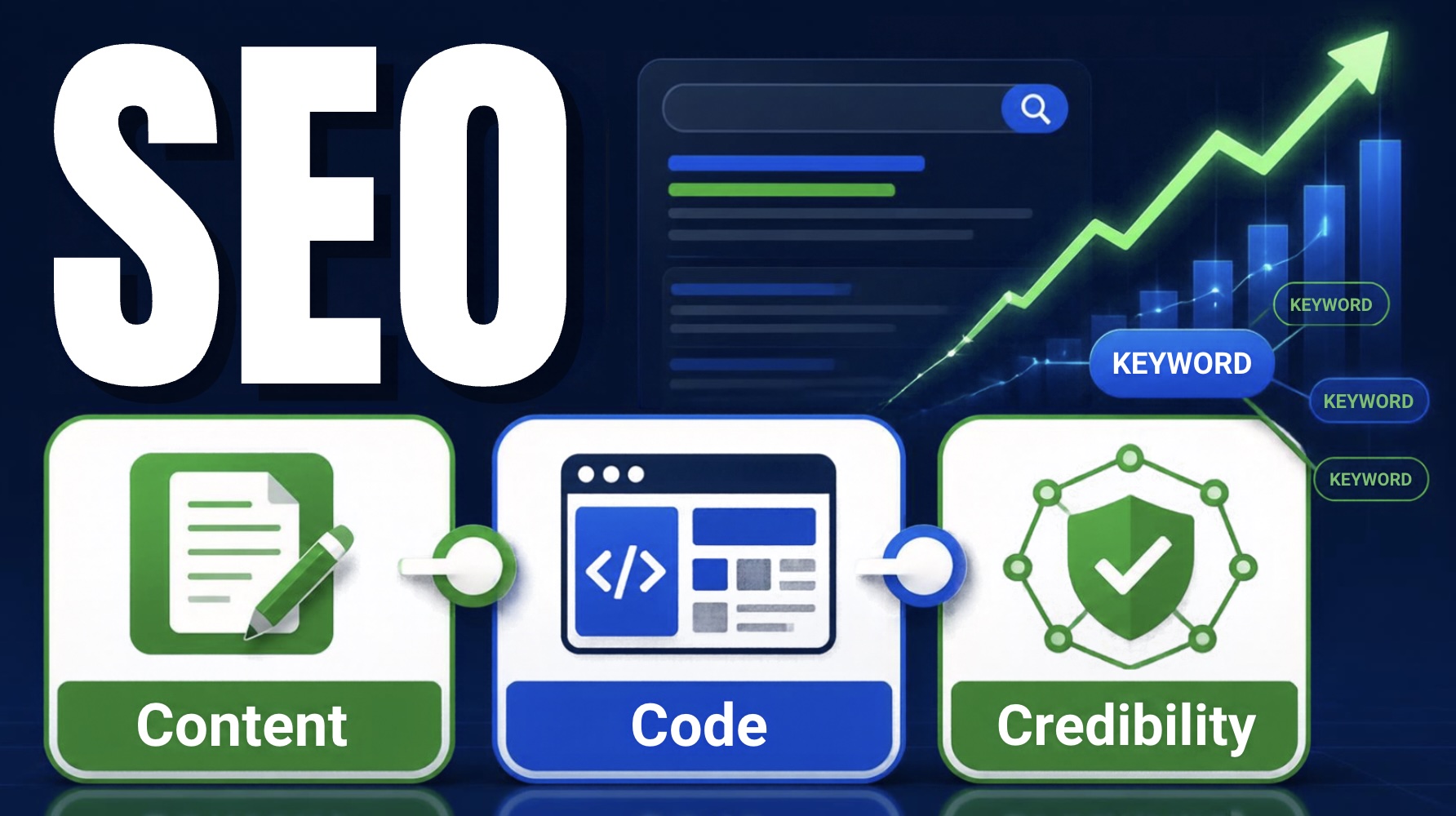
The 3 C’s of SEO are Content, Code and Credibility: whether your page satisfies the search, whether Google can access and index it, and whether your business has the signals needed to compete.
An unindexed page can’t appear in Google’s normal search results, so there is little value in rewriting it until you’ve established why it isn’t being indexed
The Three, Briefly Then The Part That Matters
Content is what a page says and whether it matches what the searcher actually wanted. Code is the technical plumbing: whether Google can crawl, render and index the page at all.
Credibility is the outside proof that you are worth trusting. You can achieve that through editorial mentions, reviews, and a brand that exists beyond your own website. Straightforward enough. The mistake is treating the three as an option to pick from rather than a sequence to run in order.
Diagnose In Order: Code, Then Content, Then Credibility
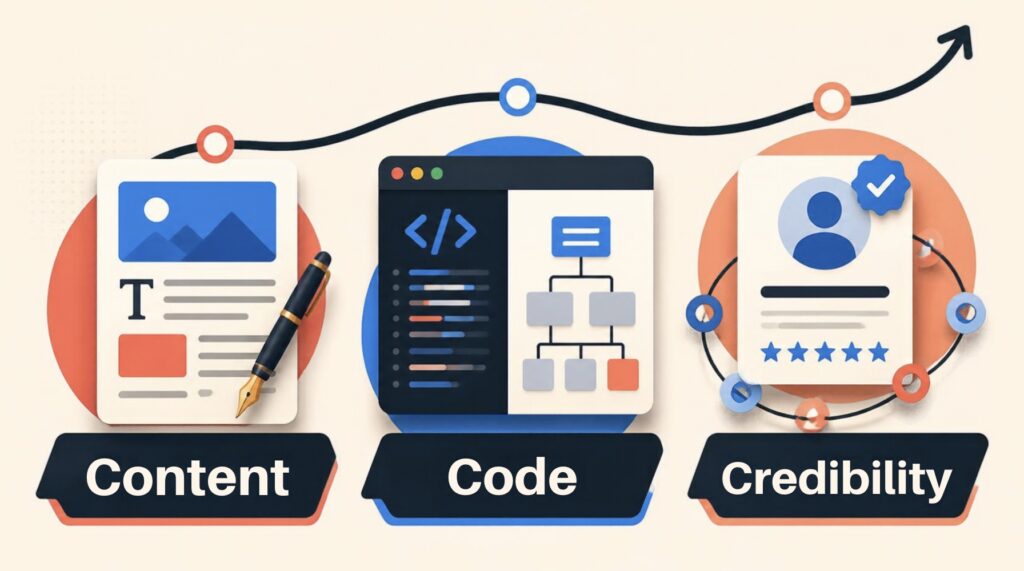
As a troubleshooting sequence, that order makes sense: first make sure Google can access and index the page, then assess whether it satisfies the search, and finally look at the signals that support trust and authority
Diagnose in the wrong order, starting with content, as most ‘content is king’ advice tells you to. And you can spend a month rewriting pages Google was never able to read.
For a lot of SMEs, ‘content is king’ is the most expensive sentence in their marketing.
Start in Google Search Console, under Indexing → Pages. Ignore the total count of excluded URLs — on its own it means nothing. The only question worth asking is whether any excluded page is one you sell from. A thousand excluded filter URLs are noise; three excluded service pages are a crisis.
A reason like ‘Crawled – currently not indexed’ on a money page means Google looked and declined; ‘Discovered – currently not indexed’ means Google knows about the URL but hasn’t crawled it yet.
Either way, that page cannot rank, and no rewrite changes that until it is indexed.
A common pattern shows the order paying off. A business cannot rank its main booking page and commissions a run of blog posts to ‘build authority’, when the page is in fact sitting under ‘Discovered – currently not indexed ’, which means it was found through the sitemap but never crawled, because almost nothing on the site links to it internally.
Interestingly, the fix here is not three months of writing but ten minutes of careful internal linking. Diagnose Code first, and you catch that in an afternoon; diagnose Content first, and you pay for a quarter of copy that was never going to move anything.
When It Really Is Content — Which Is Rarer Than You Think
Only once a page is genuinely indexed does content become the question, and ‘content’ here seldom means ‘more of it’. A page that pulls strong impressions but gets almost no clicks is not short on words. Its title is being ignored, or it is answering a different question from the one being asked.
A service page quietly ranking for informational queries can be beautifully written and commercially useless. That is a targeting fault, not a word-count one, and another thousand words will not fix it.
Credibility: Where The Standard Advice Ages Worst
Credibility is where most SMEs are told to buy backlinks, and where that advice ages worst. Volume of links is a weak, easily-gamed signal. One genuine editorial mention on a Singapore publication your customers actually read will usually outperform a hundred directory links, and it will not risk a manual penalty.
The aim is to become known for the handful of things you actually sell, not to inflate a figure in a backlink tool.
Ranking Is No Longer The Whole Game In 2026
A page can rank well and still not appear in an AI Overview. That makes clarity important: put the direct answer near the top, use descriptive headings, and make the main information easy for both people and search systems to understand.
If your answer is buried three scrolls down behind a wall of preamble, a model will not lift it. And crawler access has become a live decision: AI crawlers such as GPTBot are controlled separately in robots.txt, so it is worth knowing what you are letting in.
So before you sign off another content sprint, run the diagnosis in order and find the actual bottleneck. This guide to the 3 C’s of SEO walks through the full Search Console diagnostic, including how to read each exclusion reason and work out which C is costing you. Fix that one first, and the other two can wait their turn.
Frequently Asked Questions
Which of the 3 C’s should I fix first?
Code, in almost every case. Google cannot assess whether your content is relevant on a page it has not indexed, and it cannot weigh your credibility on a page it treated as a duplicate. Run the diagnosis in the order Code, then Content, then Credibility — fixing the earliest broken link in that chain before touching the next.
How do I tell whether I have a technical (Code) problem?
Open Google Search Console, go to Indexing then Pages, and check whether any commercially important page sits under an exclusion reason such as ‘Crawled – currently not indexed’ or ‘Discovered – currently not indexed’. The raw number of excluded URLs does not matter; whether any of them are pages you sell from does. If money pages are missing from the index, that is a Code bottleneck.
Does buying backlinks improve the Credibility C?
Rarely, and it carries real risk. The sheer number of links is a weak, easily-gamed signal, and bulk irrelevant links can attract a manual penalty. A few genuine editorial mentions from publications your customers actually read will usually do more for an SME than hundreds of directory links, without the downside.
Do the 3 C’s still matter for AI search and AI Overviews?
Yes, but the failure mode changes. A page can satisfy all three well enough to rank and still never be cited in an AI Overview, because ranking rewards depth while AI citation rewards extractability — a clear answer near the top of the section. Code matters more too, since AI crawlers such as GPTBot are controlled separately in your robots.txt.