

In Singapore, the push for more intelligent facility management systems is often driven by Operations teams rather than the IT department. Why? Because it is Operations that suffers the immediate consequences of a system failure – loss of time and increased scrutiny.
While the reality of this change is often downplayed in the strategic plans, it is very much a reality on the ground.
The truth is that most organisations feel the heat only after it’s too late. That chiller trip that shouldn’t have happened, the unexplained humidity surge that harmed valuable equipment or worse, the inexplicable and sudden rise in energy consumption and costs that seems to appear overnight without clear reason or explanation.
Here’s how smart systems ensure facilities work at optimal conditions, eliminating traditional risks:
What Defines a Modern Facility Management System?
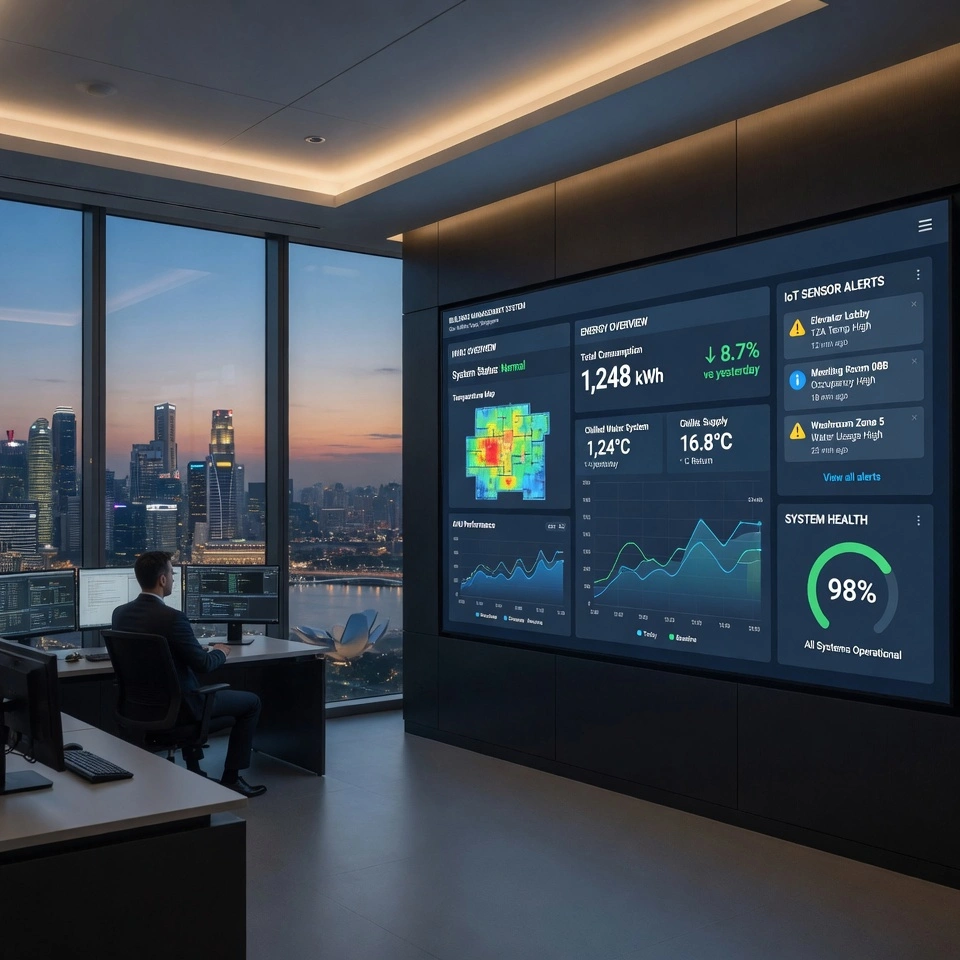
A modern Facility Management System (FMS) is more than just a program that is running in the background of your facility — it is the operational nerve of your facility.
So many of the systems we speak about throw around terms and the team don’t really get them until an unexpected event happens. We want fewer unexpected events and less firefighting.
Modern FM now moves from scheduled maintenance to early warning of asset problems, enabling a shift from minor interventions to preventing major failures.
In day-to-day facility operations, this often starts with small anomalies. A pump drawing slightly more current than usual or a chiller vibrating just outside its normal range.
Subtle signals like these are rarely detected by maintenance teams during routine inspections. The changes are just too subtle to be easily noticed.
An example from a Grade-A commercial tower in the CBD. Facilities teams for this development picked up a subtle but sustained increase in energy consumption for the chillers several weeks after it first started. There were no other symptoms of trouble and nothing appeared amiss during routine inspections.
A modern FMS quickly picked up the change and highlighted that the increase in consumption was likely due to condenser fouling caused by higher-than-average humidity.
By diagnosing the issue while it was being serviced as part of the scheduled maintenance program for the chillers at this Grade-A commercial tower in the CBD, the facilities team was able to resolve the issue before it caused a failure, leading to after-hours work, an emergency callout to a contractor and the associated tenant disruption.
Data is most visible in HVAC fine-tuning, energy optimisation and load balancing. What would normally be a matter of fixed schedules or guesswork is now visualised and monitored in an FMS.
How Does Smart Facility Management Differ From Traditional Systems?
| Paradigm Shift | Traditional / Reactive FM | Modern / Predictive FMS |
| Maintenance Approach | Scheduled or breakdown-driven | Condition-based & predictive |
| Primary Data Use | Historical records for reporting | Real-time IoT sensor data for forecasting |
| Cost Impact | High unforeseen repair costs & downtime | Planned spending, lower total cost of ownership |
| Decision-Making Style | Reactive, based on emergencies | Proactive, driven by AI-powered insights |
| Compliance Process | Manual tracking and reporting | Automated monitoring and documentation |
On paper, these differences look incremental; in live operations, they compound faster than most teams expect. And become obvious outside office hours, when fewer people are around and small issues have more room to turn into big ones.
What Are the Core Features of an Intelligent Facility Management Platform?
Most teams activate core capabilities unevenly:
- IoT Integration: Many FMS systems enable the integration of sensors around the facility. These can include vibration monitors attached to the bearings of large pieces of equipment, such as chillers, as well as indoor air quality (IAQ) sensors placed in offices. They gather data in real-time. The system can then trigger alerts when readings fall outside the expected operating parameters for the sensors, related equipment, and processes.
- Predictive Analytics: Shift from a reactive maintenance model to one that predicts failures before they occur using FMS’s Predictive Analytics. Using historical and real-time data from sensors and more, it generates alerts and notifications in advance of potential failures such as increased energy consumption that could cause damage.
- AI-Driven Insights: Within the background of the data analysis of a building and its facilities by advanced algorithms, the system works out the best possible operation of the said facilities and subsequently comes up with the corresponding actions and recommendations for the necessary execution by facility teams and their managers – without any time-consuming analysis by hand.
- Energy Efficiency & Sustainability: Monitoring of energy consumption for all facilities. Suggesting ways to increase energy efficiency and minimise waste to help meet sustainability goals as mandated by regulations.
- Compliance Automation: The facility management software automatically tracks, reports, and documents, in real time, all information related to global, local, industry, and internal compliance requirements and rules for your facility, such as Singapore’s Green Mark Plus building rating system.
You won’t activate all of these functions all at once. And probably you shouldn’t. But once you start managing your facility using live data to make operational decisions, it will make a huge difference for you and your team.
How Does the Singapore Context Shape Facility Management Needs?
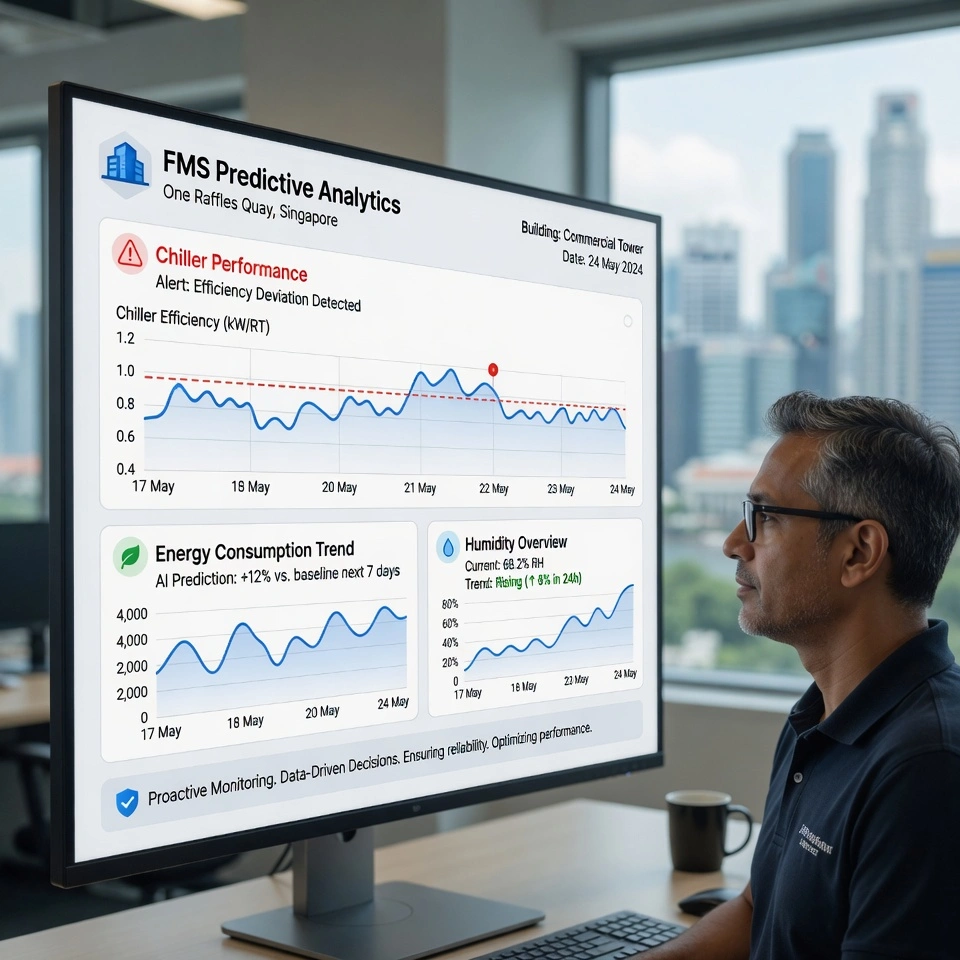
Tropical climate demands constant attention to HVAC efficiency and humidity control. With temperatures often soaring, managing air quality and cooling systems efficiently is crucial not only for comfort but also for cost savings.
These costs often escalate quietly without the right systems in place. They usually show up months later as higher energy bills or shortened equipment lifespan.
A small humidity control drift today can reduce equipment lifespan long before the issue is visible on a balance sheet.
It’s especially evident in older commercial buildings. Here, cooling systems run almost continuously, and even minor inefficiencies compound quickly under high-humidity conditions.
On the regulatory side, Singapore’s strict standards, such as BCA compliance, Green Mark Plus certifications, and SCDF safety, put pressure on building owners to adopt sustainable practices.
In a mixed-use development in Singapore, facilities teams were still manually pulling maintenance logs and system data in the 3–4 weeks leading up to annual compliance reviews.
After implementing a modern FMS with automated reporting and required documentation — from HVAC service records to energy performance summaries — they started generating all the necessary reports within minutes.
What used to be a stressful, manual scramble before audits became a routine is now a low-effort process with far fewer last-minute surprises.
Lastly, the shift toward outcome-based contracts in Singapore means that facility managers are increasingly judged on performance metrics. Like energy savings and system reliability.
How Do You Evaluate and Choose the Right Facility Management System Provider?
Of course, on paper, any selection process may look very structured. However, things change rather fast when integration questions start to pop up. Then you will find the real trade-offs among the providers you evaluated.
Assess Technology Compatibility
First, it is important to ensure that the chosen FMS is compatible with the existing facility management software and other systems in the building.
This could include integrating IoT sensors with building management systems (BMS), with solutions from Siemens (Desigo CC), Schneider (EcoStruxure), and Johnson Controls (Metasys), among others.
Look for a solution that is a ‘player’ in its own right but also a good team player, and that can interface seamlessly with existing solutions, such as smart energy monitoring systems and optimise the data gathered to deliver optimal results for the end user.
Look beyond Cost: Focus on Outcomes
When selecting a provider, focus on the tangible outcomes such as energy savings, reduced operating expenses and simplified compliance. In reality, selecting the right building automation system will provide the building owner and users with better building performance on an ongoing basis than the initial purchase price; focus on the outcomes that will occur over time.
For example, a modern FMS with predictive analytics can alert you to potential failures of building equipment and other facility-related components before they occur. The results are to save time and to prevent unforeseen repairs and resulting facility downtime.
Another kind of value that goes beyond the license’s costs and contributes to your bottom line. This is where many procurement processes lose focus, even though they were initially so clear.
Other software management systems are compared based on license costs, and the long-term impact on operational costs is usually treated as an assumption.
Consider Scalability and Flexibility
As your facility management needs evolve, your FMS should evolve with you. Thus, it is important to choose a facility management system provider that offers scalable solutions so you can expand your facility or add more smart technologies in the future.
Prioritise Strategic Partnership and Future-Ready Support
- Evaluate the proposed provider’s client service ethic.
- Assess their ability to respond to a variety of queries during the required timeframes.
- Assess their commitment to ongoing staff training and to ensuring that staff provide the customer with the best possible solution.
- Evaluate their future development roadmap.
The strongest provider will be your partner once the system is live. They will help you get the best out of the system, optimise it, upgrade it as required, and ensure that users get the best out of it too.
What Role Does Gen-AI Play in the Future of Facility Management?
Most teams are cautious here, and rightly so. You can consider an HVAC system in a large building:
- Gen-AI can track temperature patterns,
- Adjust settings for optimal efficiency, and
- Even detect early signs of malfunction.
Gen-AI’s potential extends to autonomously generating and dispatching work orders, or drafting preliminary sustainability reports.
It’s gradually becoming the coordination layer that helps facilities teams move from reacting to issues to anticipating them — often before occupants even notice something is off.
Building a Smarter, More Resilient Future
There is generally one “disaster” that continues to recur for most organisations in the hopes that it won’t. It is typically dismissed as a singular event until it recurs in subsequent quarters.
By that time, it is clear but still unknown why this continues to happen.
As an organisation moves towards an intelligent, integrated FMS, it will become visible, predictable and manageable by highlighting and bringing under control the recurring issues that plague its current state.
Take the next step: evaluate providers who understand Singapore’s specific context. Or schedule a consultation with a facility management service provider to see how predictive insights could transform your most critical assets.